

When you are considering acquiring a giant LED screen, You will encounter specific technical terminology that can be confusing. To help you better understand these terms and navigate technical specifications or price quotes, we have created this detailed glossary. This article will allow you to understand the key concepts for making informed choices regarding digital signage.
LED boxes and modules: Flexibility and modularity
THE LED screens are built from boxes, also called offices Or slabs, These modules, which fit together like Lego blocks, allow for the creation of screens of varying sizes, tailored to the client's needs. Each module is manufactured in specific dimensions (e.g., 500x500mm or 1280x960mm) and is selected according to the application. The modules are secured with a locking system that ensures perfect pixel alignment, providing a continuous image without visual interruptions.
Each box contains LED modules, These are modules where the electronic circuits and LEDs are mounted. One of the major advantages of LED screens is that if a module fails, it can be replaced without having to change the entire screen. For indoor screens, the housings are often made of die-cast aluminum, ensuring high precision and lightness, while outdoor screens use more robust housings to withstand the elements.

LED Technology: SMD vs DIP
THE LED (Light Emitting Diode) is the fundamental technology behind screens. There are two main types of LEDs: DIP and the SMD. THE LED DIP (Dual In-line Package) are still widely used for outdoor applications due to their stability and high brightness, making them particularly effective in direct sunlight. In contrast, the SMD LED Surface-mounted devices (SMDs) are more modern and offer better resolution, with miniaturization that allows for the integration of three different colored LEDs into a single capsule. SMD It is therefore often preferred for high-resolution indoor displays and is starting to be used outdoors thanks to its brightness and wide viewing angle.
Pitch, resolution, and pixels: Keys to image quality
THE pitch The pixel pitch refers to the distance between the LEDs on a screen, expressed in millimeters (P1.9mm, P2.5mm, etc.). The smaller the pixel pitch, the sharper the image, and the closer the screen can be viewed without loss of quality. For example, a pitch Smaller sizes will be used for LED screens in spaces like entrance halls or lobbies, where viewers are close to the screen. The pitch also determines the resolution, which is the total number of pixels (LEDs) present across the height and width of the screen.
Reducing the pixel pitch exponentially increases pixel density, thus improving image quality. LED screen with a smaller pitch will therefore have a better resolution, allowing for a sharper image and optimal rendering, even at very close range.
Brightness and light: Optimal visibility indoors and outdoors
There brightness The brightness of an LED screen is measured in nits, a standard unit for evaluating the brightness performance of a screen. A interior screen has a brightness between 800 and 1500 nits, while a outdoor screen can reach between 4000 and 8000 nits, or even more for installations in direct sunlight. It is important to choose a brightness level appropriate for the screen's location to ensure optimal visibility, especially if the screen is located behind a window exposed to direct sunlight.
Control system: Manage content easily
THE control system an LED screen works thanks to a mailing card (sending card) which transmits the information to be disseminated, such as images or videos, to reception cards installed in each cabinet, these cards coordinate the different modules to display a consistent and uniform image across the entire screen. Everything is connected to a... PC player who, thanks to our software HTV Play, allows for remote and real-time content management.
IC Drivers and Refresh Rates: Display Performance
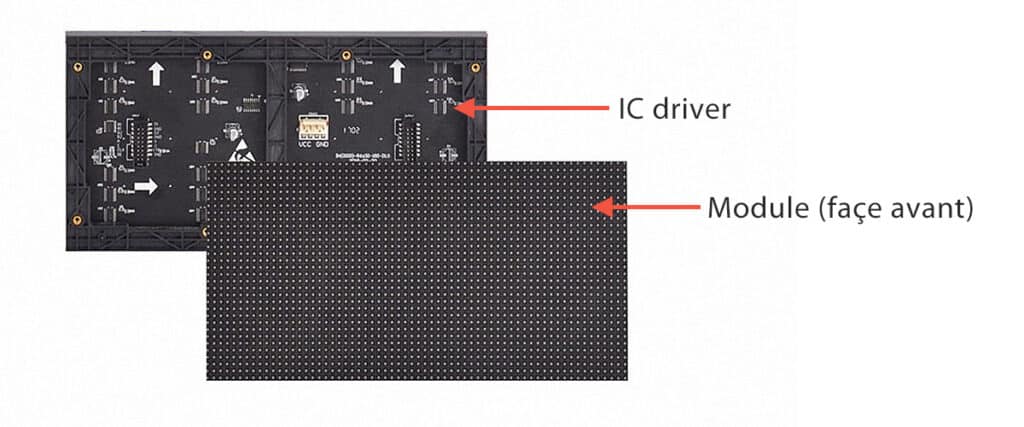
THE IC drivers These are microprocessors located on the LED modules that influence critical factors such as refresh rate, brightness, and image stability. These components are particularly important for screens intended for filming, such as in stadiums or concert halls, as they ensure a fluid image without flickering. The refresh rate, The refresh rate, measured in Hertz (Hz), corresponds to the number of times the image refreshes per second. A high rate (above 4000Hz) is essential for screens displaying live events or footage captured by cameras.
Ingress Protection (IP) rating and connectors: Resistance to the elements
Outdoor LED screens must be resistant to weather conditions and meet the criteria of the’Ingress Protection (IP) rating. For example, an outdoor screen must have a IP65 rating, guaranteeing that it is protected against dust and water. This international code is a reliable measure of the weather resistance of LED screens. Furthermore, the electrical and data connectors must be resistant to temperature variations and IP65 certified to guarantee maximum protection.
Conclusion: Mastering technical terms is key to a successful project
This glossary helps you better understand the specific terms related to LED screens, from the modular structure of the enclosures to LED technology, including brightness and control parameters. With this understanding, you will be able to better comprehend pricing and technical specifications. For any questions or further information, the team at HTVLED is available to guide you through every step of your digital signage project.


